Binh Dinh: Stepping up transport infrastructure
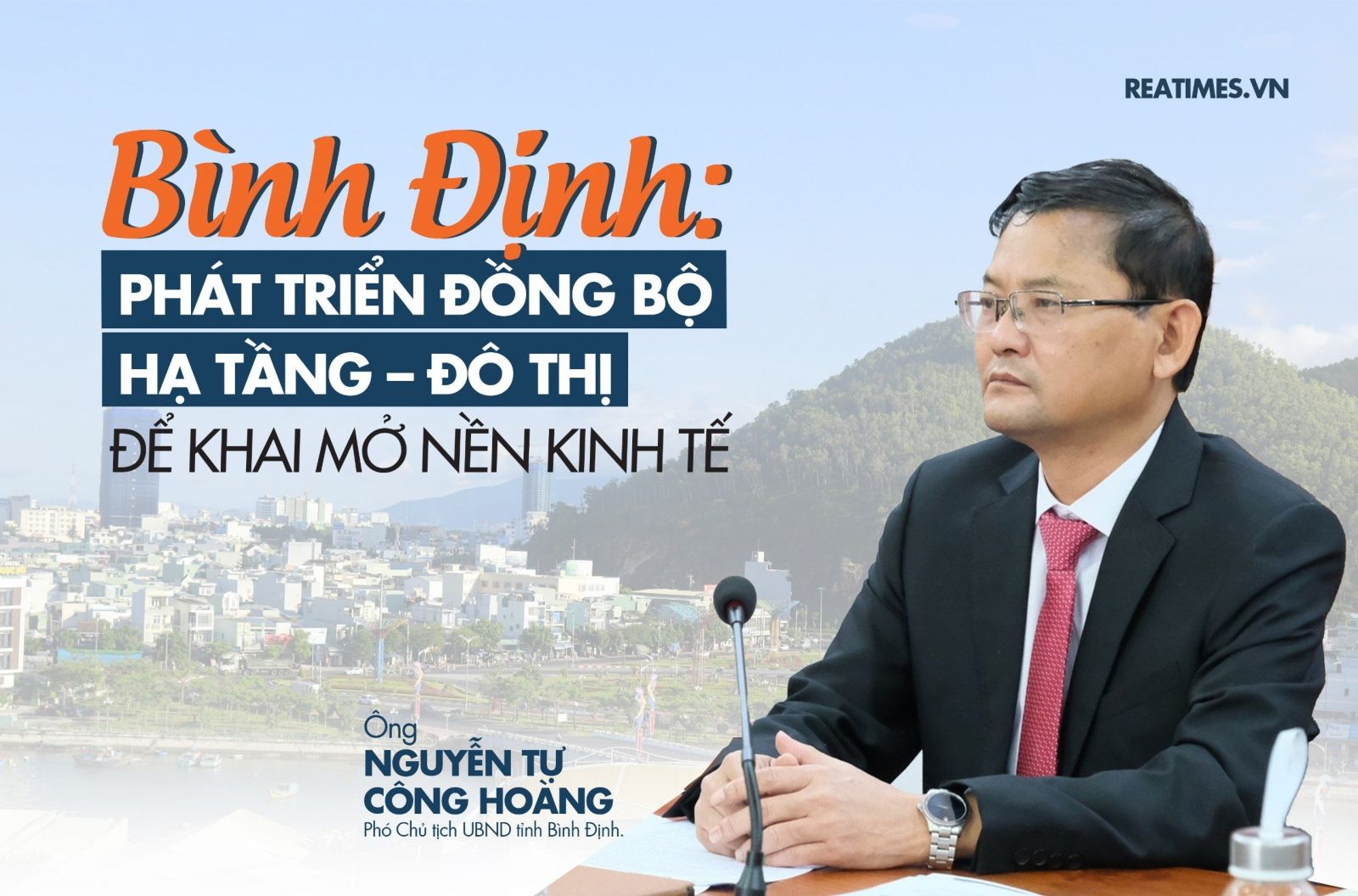
 “I believe that transport infrastructure has the mission of going first to ‘pave the way’ to open up the economy, creating momentum to attract investment and tourists and develop urban areas and industrial parks, with connectivity that benefits many other economic sectors in the province,” said Mr. Nguyen Tu Cong Hoang, Vice Chairman of the Binh Dinh Provincial People’s Committee, on the leverage strategy to drive Binh Dinh’s economic development in the coming period.
In the first months of the year, the Binh Dinh Provincial People’s Committee set up working groups to regularly inspect, urge, remove difficulties and obstacles, and support stepping up disbursement of public investment capital in 2023. As a result, the province’s public investment disbursement rate has consistently been among the leading group nationwide. This is a “catalyst” for projects and works to speed up, especially the construction of key transport works and connecting these routes into a network.
Binh Dinh has been focusing on master planning and regional planning, and on investing in and upgrading urban areas and developing the ecological environment.
Thanks to this breakthrough, together with outstanding potential and a location within the Central key economic region, in recent years Binh Dinh has emerged as the focal point of the Central real estate market, attracting large enterprises.
Reatimes spoke with Mr. Nguyen Tu Cong Hoang, Vice Chairman of the Binh Dinh Provincial People’s Committee.
Infrastructure that “goes first and paves the way”
Reporter: Recently, Binh Dinh province has been making gradual breakthroughs in transport infrastructure. Has Binh Dinh chosen transport to “go first and pave the way” for the province’s economic development?
Mr. Nguyen Tu Cong Hoang: That’s right. Transport is likened to the arteries of the economy and plays a key role in economic growth, creating breakthroughs and momentum for economic development and promoting regional linkages. Only with synchronized, modern transport infrastructure that meets the needs of freight and passenger transport can the economy have the conditions to grow quickly, stably and sustainably.
Reality also shows that the more a place develops diverse, convenient and highly connected transport infrastructure with short travel times from one area to another, the faster its economy grows and the stronger that locality’s “appeal.” So the motto of “transport goes first to pave the way” is an urgent requirement of reality and is creating breakthroughs in the province’s socio-economic development.
The Resolution of the 20th Binh Dinh Provincial Party Congress also identified investing in and completing synchronized transport infrastructure as one of the three breakthroughs of the 2020–2025 term.
In recent years, Binh Dinh has clearly set the goal of focusing on developing important transport infrastructure to remove bottlenecks, ensure regional and inter-regional connectivity, and expand urban space. At the same time, this contributes to bringing Binh Dinh province into the top 5 leading developed provinces of the Central region within the next 5 years.
This is reflected in 2021–2025, when budget investment capital for transport is quite large (VND 13,823.513 billion, accounting for 32.6%) of the province’s total medium-term public investment capital for 2021–2025.
Transport infrastructure in the province is being gradually completed and is fairly seamlessly connected, covering all 05 modes – road, rail, air, sea and inland waterway – providing convenient connections with the whole country and countries in the region; it increasingly meets the province’s development requirements and creates a new look for urban and rural areas.
Some important projects have been completed and put into use, such as: the road to Phu Cat Airport, the road to Dieu Tri Station, the Nhon Hoi Economic Zone axis road, National Highway 19 from Quy Nhon Port to its junction with National Highway 1A, the province’s western road (DT639B), Km130–Km143+787, and the new coastal road DT.639 (sections: Cat Tien – My Thanh, Lai Giang – Thien Chanh)…
In addition, Binh Dinh continues to direct faster investment and site clearance for construction of the following works and projects: the Eastern North–South Expressway through the province; the coastal road (sections from National Highway 1D to the new National Highway 19; the extended Dien Bien Phu – Diem Van section; the Cat Tien – Diem Van section and the My Thanh – Lai Giang section); the southern bypass of Phu Phong town; the DT.633 bypass from Nui Ghenh to the coastal road (DT.639); local roads connecting to the coastal road; and roads connecting to the Becamex VSIP Binh Dinh Industrial, Urban and Service Park.
Currently, the Binh Dinh Provincial People’s Committee is working with the Ministry of Transport to complete site clearance and build the expressway and the rest stop of the Eastern North–South Expressway through the province.

In addition, the province is also preparing to invest in the Quy Nhon – Pleiku Expressway project, the Phu Cat Airport upgrade and expansion project, and the Quy Nhon Port expansion project; and to review and add several seaports and port areas in Binh Dinh province to the Master Plan for the Development of Vietnam’s Seaport System for 2021–2023, with a vision to 2050, and the detailed plan for groups of seaports, wharves, piers, buoy berths, water areas and water zones for 2021–2030, with a vision to 2050…
Thus, it can be seen that complete, synchronized infrastructure investment will allow Binh Dinh province to plan new development space for urban, industrial, commercial, service and tourism uses, and create important transport corridors linking Quy Nhon Port and Phu Cat Airport with regions across the country. On that basis, Binh Dinh province will plan a new development space for the province to attract domestic and foreign investors.
Reporter: Which sectors will well-invested transport infrastructure help Binh Dinh attract in the time ahead?
Mr. Nguyen Tu Cong Hoang: I believe that transport infrastructure has the mission of going first to “pave the way” to open up the economy, creating momentum to attract investment and tourists and develop urban areas and industrial parks, with connectivity that benefits many other economic sectors in the province, including:
First, agriculture, forestry and fisheries: livestock and poultry processing plants; food and functional food processing; seafood processing; agricultural and forestry product processing…
Second, industry: infrastructure of industrial parks and clusters; plants making components, and manufacturing and assembling automobiles; specialized electric motors; electric wire and cable, electrical equipment and accessories; high-end fashion and footwear products; software production centers, data centers (Big Data) and renewable energy projects (wind, solar…)…
Third, port services and logistics: deep-water ports, the Phu My logistics center, ICD inland container depots, and logistics in Van Canh and Tuy Phuoc…
Fourth, tourism: the Tan Thanh tourist area in Phu Cat district; the Night Paradise Nhon Hoi entertainment area; the Eo Vuot tourist area; the Thi Nai Lagoon eco-tourism area; and the K200 high-end hotel area, all in Quy Nhon City; the Tay Son golf course, the Vinh Son experiential eco-tourism area; and the eco-tourism area in Vinh Thanh district…
Fifth, urban economy: South De Gi and North De Gi urban areas; the urban areas east of Thi Nai Lagoon, Quy Nhon City…
Building the urban system in both “breadth” and “depth”
Reporter: Besides stepping up infrastructure, how are urban planning and development going?
Mr. Nguyen Tu Cong Hoang: Recently, Binh Dinh’s urban system has received increasing attention and investment from authorities at all levels in both “breadth” and “depth”.
In addition, smart urban planning and green-growth urban planning in the province are also regularly attended to and directed.
To effectively carry out urban development plans toward smart cities and green-growth cities, Binh Dinh province has recently implemented many plans and programs in a synchronized manner, such as: opening the Smart City Operations Center (IOC) and developing smart cities; issuing the Plan for green-growth urban development in Binh Dinh province to 2030; and issuing urban development programs for Quy Nhon, Hoai Nhon, An Nhon, Phu Phong…
Binh Dinh province has also issued the Green Growth Action Plan for 2023–2030 with the goal of promoting economic restructuring tied to renewing the growth model, to achieve economic prosperity, environmental sustainability and social equity. From there, the province will move toward a green, carbon-neutral economy and contribute to the goal of limiting the rise in global temperature.
Building urban public green spaces tied to natural water surfaces, lakes, rivers and the sea has always received attention and will help make good use of landscape potential and advantages.
Several smart and green-growth urban areas are being built and formed, such as: Long Van New Urban Area, Dai Phu Gia Urban Area, An Phu Thinh, the coastal parks along Xuan Dieu street, Nguyen Tat Thanh Square, Chien Thang Square, the park along An Duong Vuong street… which have created a new, spacious, modern look and contributed to urban development.

Reporter: Yes! With rapid breakthroughs in both infrastructure and urban areas, Binh Dinh has been attracting many investors, quality enterprises “pouring in“. So what preparations has the province made?
Mr. Nguyen Tu Cong Hoang: To be ready to attract new projects, in investment promotion we have flexibly applied both in-person and online formats to invite well-resourced, strongly branded domestic and foreign investors to invest in the province’s key projects.
Specifically, we have held investment promotion in countries with large economies such as Japan, Germany, Thailand, South Korea and Italy… In the future, we will continue investment promotion in markets such as the United States, Canada and Israel…
Based on the province’s socio-economic development plan, the investment attraction situation and the characteristics of each locality, we have built the province’s List of Projects Calling for Investment for 2023–2025. The list is built to suit investment demand, the province’s overall development plan and the shift in economic structure, and applies incentive policies as prescribed.
In practice, to promptly remove difficulties and obstacles in construction investment and in businesses’ production and trading activities, on 26/6/2023 the Provincial People’s Committee also held a meeting and dialogue with businesses in the province in 2023, attended by nearly 400 local businesses. At that event, the province also announced the launch of a Hotline to promptly advise on and answer questions from businesses in Binh Dinh province.
As a result, the province’s investment attraction outcomes so far are very positive. As of 15/9/2023, the province had newly attracted 64 projects (60 domestic projects, 4 FDI projects) with total registered capital of VND 14,204.877 billion (64/60 projects, reaching 105% of the 2023 full-year plan), and adjusted 58 projects with additional capital of VND 3,770.851 billion.
These results are very encouraging, and we will be more determined and make greater efforts in investment promotion and attraction so that Binh Dinh province can break through even further.
A new driving force for the real estate market to rise
Reporter: Is it thanks to the boost from the province’s rapid and synchronized and strong development in recent times that the real estate market has risen quickly in price and heat?
Mr. Nguyen Tu Cong Hoang: Accelerated disbursement of public investment, transport infrastructure development and the appearance of mega-urban areas are also the “big wind” driving the real estate market upward.
In recent years, Binh Dinh real estate has become a destination for the real estate community. Many investors have decided to pour capital into large projects worth thousands of billions of dong, typically: Hung Thinh Residential Area; An Phu Thinh Urban Area; the new Cho Goc urban area (CG01); Anh Viet Residential Area; the Artificial Intelligence Center – auxiliary urban area (Quy Nhon City); and the NDT-1 Urban Area west of (new) National Highway 19…
I believe that the real estate market plays an important role in the economic “ecosystem” and is directly related to many economic sectors such as the construction industry, services, tourism, accommodation, materials production, finance and banking; it also affects production chains such as materials, steel, household goods, the capital market, credit and the labor market, affecting macroeconomic stability, growth, social security and jobs.
Therefore, managing and developing the real estate market well will create favorable conditions to attract investment and mobilize huge internal resources, contributing to the province’s socio-economic development.
However, recently the real estate market has faced many difficulties for many reasons, including objective ones such as: the slowdown of global economic growth, epidemics, the market’s growth cycle, lower economic growth and low liquidity.
With great advantages and potential, having both the sea and breakthroughs in transport and urban infrastructure development, Binh Dinh’s real estate market has also faced “undercurrents” that cause disruption more than once, especially in late 2021 and early 2022, when land fever spread across the country.

To ensure the province’s real estate market develops in a stable, healthy and sustainable way, the Provincial People’s Committee issued Plan No. 102/KH-UBND dated 31/05/2023 to implement the Government’s Resolution No. 33/NQ-CP dated 11/03/2023 on solutions to remove obstacles and promote the safe, healthy and sustainable development of the real estate market.
The province also directed relevant departments and agencies to continue advising on and properly carrying out the appraisal and approval of investment policies, ensuring rigor, compliance with the law, and consistency with the province’s plans and development needs.
At the same time, the province has comprehensively reviewed the list of housing and real estate projects in the area, assessing specific reasons for projects that have been approved for investment but not yet started or are delayed. On that basis, it focuses on removing legal and procedural difficulties in preparing housing project investments so they can be implemented as prescribed.
In addition, we have also directed investment inspection, examination and supervision; supervision of bidding activities to select investors for urban area, residential and housing projects; and management and monitoring of projects from investment approval through implementation and the fulfillment of financial obligations to the State.
On the other hand, the province has also directed the competent agencies to focus on doing a good job of compensation and site clearance, especially by resolving difficulties and obstacles related to compensation, in order to create land for investors to carry out projects. It has directed the public disclosure of planning information and the progress of urban area, housing and infrastructure development projects, especially large-scale projects, to make information transparent and prevent rumor-mongering and speculation aimed at inflating prices for illegal gain; to promptly prepare, appraise and approve urban and rural construction plans and land-use plans and schemes; and to control, detect, prevent and strictly handle violations in land-use-right auction activities to ensure compliance with the law.
In addition, there are measures to manage and prevent subdivision and “plot-splitting and lot-selling” in areas not yet permitted for investment and lacking infrastructure; to strengthen control over the activities of real estate trading floors and of organizations and individuals practicing real estate brokerage; and to correct hand-to-hand trading and price inflation that distort real estate market information./.
Reporter: Thank you, sir!
25/09/2023 06:00